
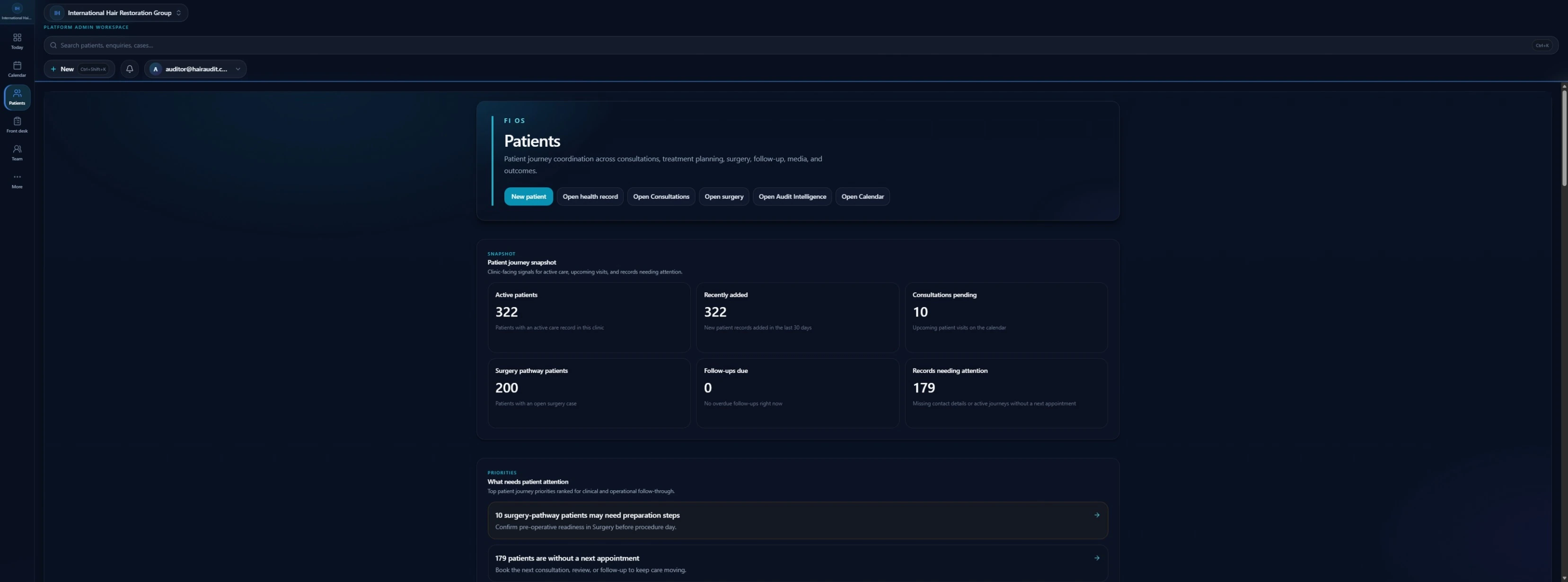
PatientOS
Follow the patient journey through every stage of care.
Platform
Follicle Intelligence connects acquisition, consultation, clinical intelligence, surgical planning, auditing, training, analytics, and long-term patient intelligence into one integrated platform.
Architecture
Generic software manages isolated tasks. Each product optimises its own screen while context fragments across spreadsheets, inboxes, and local habits.
Follicle Intelligence connects every operational, clinical, educational, and intelligence layer of a hair restoration organisation—so decisions inherit the same patient story, evidence posture, and governance history from first touch through lifetime outcome.
Four integration bands · one spine
Demand, pipeline discipline, scheduling, services, and day-to-day clinic rhythm—wired into the same tenant policy and record spine.
Structured assessments, longitudinal records, Patient Twin™, the FI Patient App, and AI-assisted pathways—without divorcing clinical nuance from operational reality.
Planning, procedure-day execution, photography and evidence, independent review, and quality scoring that institutions can run under scrutiny.
Competency programs, revenue and conversion intelligence, productivity KPIs, and the structured outcome substrate that sharpens cohorts over time.
Module surface
Each module is a product-grade surface with explicit integration contracts. Together they form the architecture serious operators deploy—not a loose bundle of features. The FI Patient App extends that architecture to the patient.
Enquiry, pipeline, ownership, follow-up — connected to the patient journey.
LeadFlow is the acquisition and relationship layer of FI: native enquiry, pipeline, assignment and follow-up, with controlled HubSpot connect, coexistence and staged transition.
What it connects
ClinicOS availability, PatientOS identity, ConsultationOS handoff, AnalyticsOS funnel views.
Why it matters
Growth without operational coupling creates leakage. LeadFlow keeps demand, accountability, and downstream clinical context aligned.
Scheduling, appointments, staff availability, services, daily operations.
ClinicOS runs the operational heartbeat: calendars, services, rooms and roles, appointment lifecycle, and the constraints that consultation and surgery inherit.
What it connects
LeadFlow pipeline, PatientOS records, ConsultationOS bookings, AnalyticsOS operational KPIs.
Why it matters
When scheduling is disconnected from clinical workflow, capacity lies. ClinicOS makes operational truth portable across modules.
Patient records, timelines, Patient Twin, longitudinal intelligence.
PatientOS is the longitudinal substrate: demographics, encounters, media, assessments, procedures, and the Patient Twin™ narrative that other modules read and enrich.
What it connects
Every clinical and governance module—consultation, imaging, surgery, audit, analytics — and the FI Patient App as the patient-facing continuation of the same journey.
Why it matters
Hair restoration is a multi-year story. A fragmented chart makes every downstream module weaker; a unified record compounds intelligence responsibly.
Patient-facing next steps, milestones, documents and journey participation.
The FI Patient App is the secure patient-facing mobile surface for actions, milestones, next steps, quotes, documents, pathology and journey communication — connected directly to clinic workflows in FI.
What it connects
PatientOS longitudinal record, ClinicOS operations, ConsultationOS quotes and pathways, SurgeryOS milestones, ImagingOS and AuditOS evidence loops, Event Bus notifications, Security and Integration layers.
Why it matters
Clinic workflows are only effective when patients know what happens next. The Patient App closes the loop between staff-managed journeys and patient participation.
Assessment workflows, diagnosis, recommendations, quotes, clinical handoff.
ConsultationOS structures the consult lifecycle: discovery, clinical assessment, recommendations, pricing and quotes, consent posture, and handoff into planning and scheduling.
What it connects
PatientOS history, ClinicOS appointments, HairIntel pathways, SurgeryOS planning inputs.
Why it matters
The consult is where expectations are set. Structuring it reduces variance, improves traceability, and feeds better planning and audit evidence later.
AI intake, diagnostic pathways, blood interpretation, risk scoring, treatment planning.
HairIntel brings model-assisted intake and classification alongside human judgment—standardising history capture, triage, and documentation density before clinicians commit time.
What it connects
ConsultationOS assessments, PatientOS timelines, SurgeryOS planning context, AuditOS evidence expectations.
Why it matters
AI value is not a chat window; it is consistent structure at scale. HairIntel increases signal quality entering human decision points.
Surgical planning, graft targets, donor intelligence, procedure day tracking, follow-ups.
SurgeryOS carries the surgical programme: targets, donor assessment, day-of workflow, graft accounting, post-operative milestones, and continuity into outcomes.
What it connects
ConsultationOS plans, PatientOS record, imaging and photography surfaces, AuditOS review packets.
Why it matters
Surgical quality is where reputation is won or lost. SurgeryOS aligns planning, execution telemetry, and follow-up in one governable thread.
HairAudit integration, independent review, evidence capture, quality scoring, benchmarking.
AuditOS is the governance and evidence layer: HairAudit-aligned review, structured scoring, disclosure separation, and benchmark-ready cohort participation where policy allows.
What it connects
SurgeryOS cases, imaging evidence, PatientOS outcomes over time, AcademyOS remediation tracks, AnalyticsOS standing.
Why it matters
Benchmarks without review discipline are marketing. AuditOS encodes the institutional habits regulators and boards expect to see under diligence.
International Institute of Hair Restoration training, certification, competency tracking.
AcademyOS links standards-led training and certification to real-world performance signals—so education is not detached from cases, audits, and operational reality.
What it connects
AuditOS findings, ClinicOS staffing roles, AnalyticsOS competency and productivity views.
Why it matters
Training that does not close the loop on outcomes decays. AcademyOS ties curriculum, credentialing, and improvement cycles to the same platform spine.
Revenue, conversion, productivity, operational KPIs, outcome intelligence.
AnalyticsOS turns structured platform events into executive and clinical operations views: funnel integrity, utilisation, revenue integrity, and outcome-linked productivity.
What it connects
LeadFlow, ClinicOS, PatientOS, AuditOS, AcademyOS program completion.
Why it matters
Dashboards built on fragmented extracts go stale. AnalyticsOS inherits semantics from modules so KPIs mean the same thing across sites.
Enterprise clinic deployment, module activation, and sandbox onboarding.
OnboardingOS is the enterprise deployment engine for new clinic tenants—guided provisioning sessions, clinic configuration templates, module bundle planning, role packs, and sandbox training environments that accelerate safe adoption.
What it connects
ClinicOS services, module entitlements, AcademyOS training tracks, WorkforceOS bootstrap, and platform admin governance.
Why it matters
Multi-clinic groups cannot scale on manual setup. OnboardingOS standardises how new organisations enter the FI ecosystem with repeatable, reviewable deployment templates.
Structured outcome data, benchmarking, predictive intelligence foundation.
The Global Intelligence Network is the cross-tenant, policy-governed layer where anonymised or consented structured outcomes can sharpen cohorts, baselines, and standing—without collapsing clinical judgment into a single score.
What it connects
AuditOS cohorts, AnalyticsOS aggregates, research and standards partners where contractually enabled.
Why it matters
Category leadership compounds when evidence depth and governance history grow together. The network is the long-range substrate for defensible benchmarks.
FI OS modules
Patients, LeadFlow, calendar and surgery — connected clinic workflows in one environment.
PatientOS
Follow the patient journey through every stage of care.
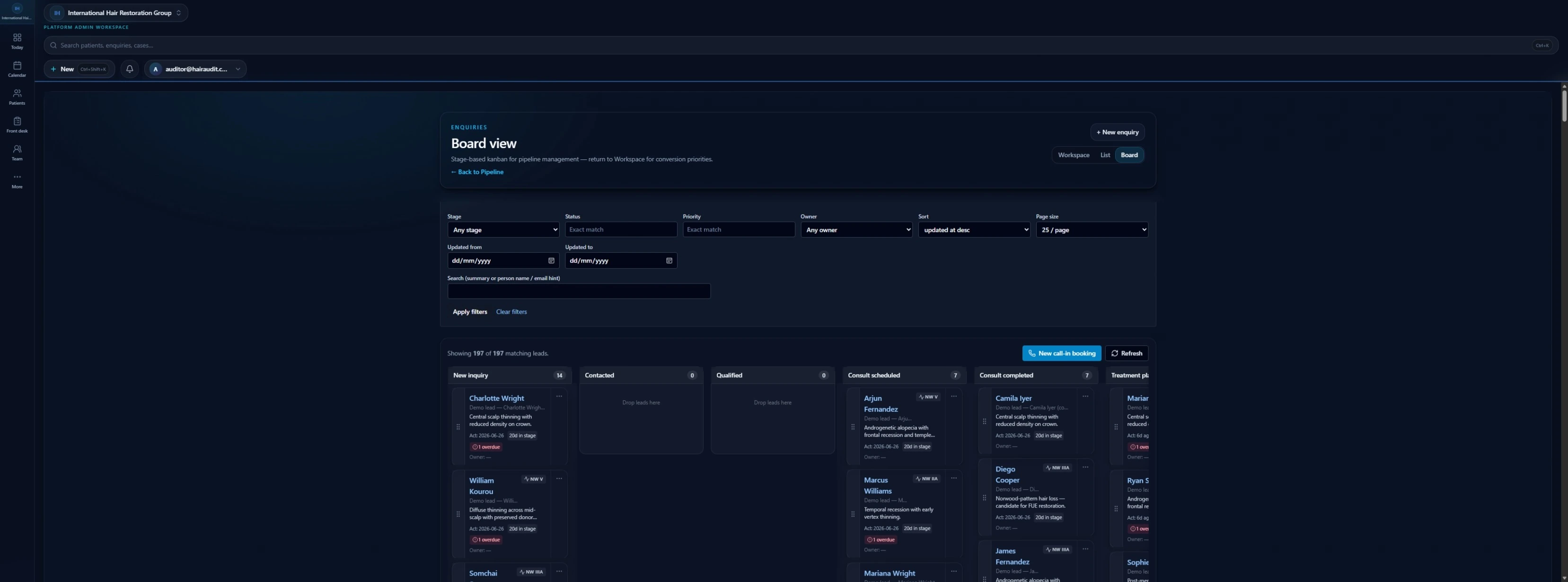
LeadFlow
Manage ownership, follow-up and conversion.
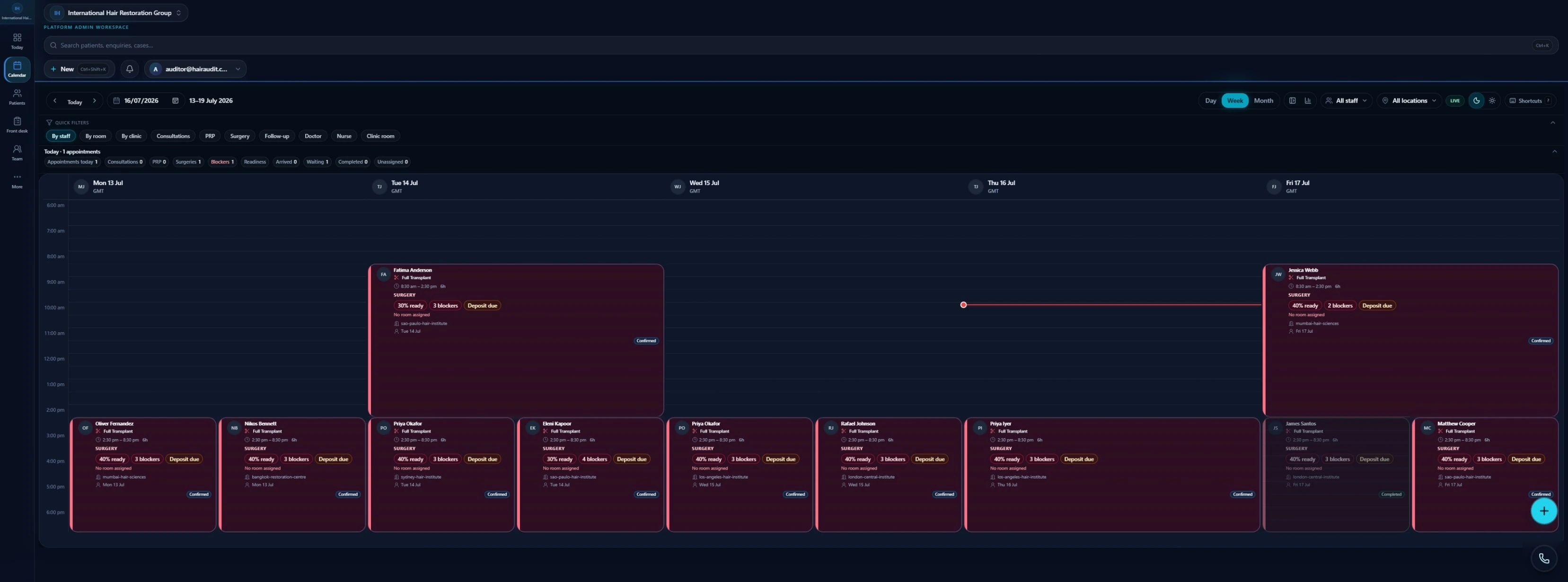
CalendarOS
Coordinate consultations, treatments, teams and surgery.
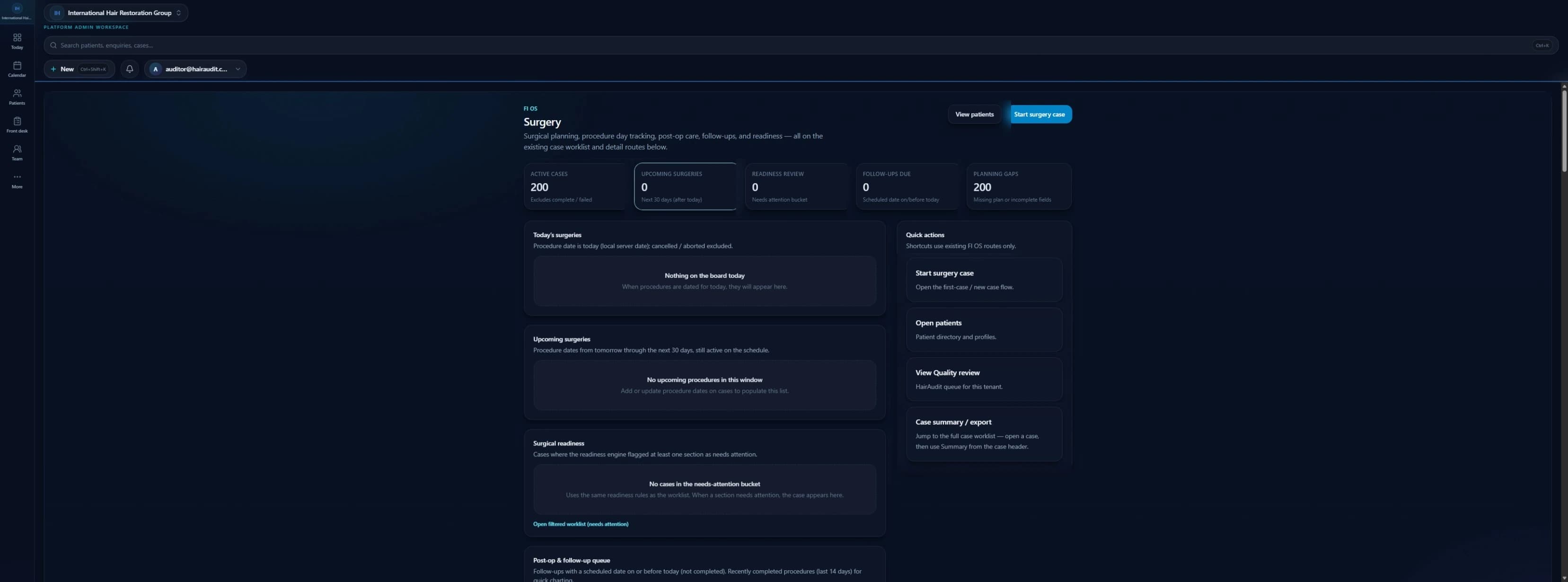
SurgeryOS
Coordinate planning, readiness, procedures and follow-up.
Interface shown with demonstration data.
Operating loop
The value is not in digitising one step—it is in connecting every step so evidence, accountability, and learning move forward with the patient instead of restarting at each handoff.
Lead capture
Consultation
Diagnosis
Treatment plan
Surgery plan
Procedure
Follow-up
Audit
Outcome intelligence
Training feedback loop
Scale patterns
Deploy a complete OS without stitching vendors: acquisition, operations, clinical intelligence, surgery, and audit-ready evidence in one tenant envelope.
Standardise modules and policy while preserving brand variation: shared benchmarks, role templates, and governance visibility across a growing footprint.
Run multi-brand, multi-region programmes with separation of duties, review queues, exportable diligence packets, and analytics that respect group and local semantics.
Anchor standards programs and independent review on the same structured evidence model clinics already generate—reducing friction between practice and profession.
Compounding intelligence
Every consultation, patient record, procedure, audit, and outcome can become structured intelligence that the platform retains under explicit policy—so cohort definitions, baselines, and governance history deepen with serious use.
As structured data grows, Follicle Intelligence can support richer operational forensics and may help teams prioritise improvement opportunities with clearer denominators and traceability.
Predictive and assistive features, where enabled, should remain adjuncts to clinical judgment; the architecture is built so human accountability stays visible even as models assist.
Follicle Intelligence™ connects HairAudit (surgical evidence and audit surface), Hair Longevity Institute (biology and longitudinal treatment intelligence), and International Institute of Hair Restoration (structured training programs, standards, and governance alignment).
Next step